REIMAGINE WORK

When work goes wrong, we usually look at people.
A difficult employee, a weak manager, a team that can’t get along. The Basic Human Needs Framework looks underneath. It names what every person needs in order to do their best work, and it shows what happens when those needs go unmet.
What the framework is
The Basic Human Needs Framework is Workplace Peace Institute’s model of the conditions people need in order to thrive at work. It brings together two bodies of work:
Human needs theory, from conflict scholar John Burton, who showed that needs like identity, participation, recognition and security are universal. People pursue them whether or not their workplace makes room for them.
Dignity, as defined by Dr. Donna Hicks, who describes dignity as our inherent value and worth: something we are born with, and the starting point for how we treat each other. Her essential elements of dignity form the center of the framework.
The framework at a glance
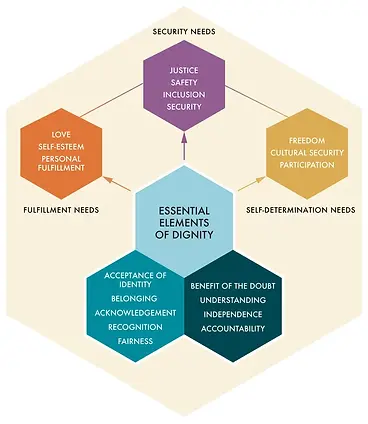
The framework places the essential elements of dignity at the center. Around it are three groups of needs: security needs, self-determination needs and fulfillment needs. They work side by side, not as rungs on a ladder. When the essential elements of dignity at the center are honored, they feed the needs in the outer ring, and the whole system becomes self-perpetuating.
The human needs
Three groups of needs surround the center of the framework. They work side by side, not as steps on a ladder.
█ Security needs
The ground people stand on: fairness, safety, inclusion and a secure place at work.
█ Self-determination needs
Room to be yourself and to shape your own work.
█ Fulfillment needs
What helps people flourish: care, confidence and the satisfaction of reaching their goals.
█ At the center: dignity
The essential elements that feed every other need. More on these below.
Security needs
Justice: having access to the resources needed to reach one’s potential.
Safety: freedom from bodily harm and from humiliation, and the freedom to speak without fear of retribution.
Inclusion: feeling that you belong, whatever the relationship or community.
Security: confidence that your place and your contribution in the organization are stable and honored.
Self-determination needs
Freedom: autonomy over tasks, schedules and approaches to work, balanced with clear expectations and accountability.
Cultural security: having one’s cultural identity, heritage and way of life fully embraced at work.
Participation: a voice in, and representation in, the processes and decisions that shape one’s role and work life.
Fulfillment needs
Love: the mutual willing of good for one another at work.
Self-esteem: a healthy sense of confidence and well-being at work.
Personal fulfillment: the contentment that comes from reaching one’s professional goals.
Our understanding of love at work draws on Dr. Barbara Fredrickson’s Love 2.0 (Hudson Street Press, 2013).

Safety and inclusion live in two places.
They are security needs, and they are also essential elements of dignity. That overlap is the point: when people feel unsafe or shut out, it isn’t only a need going unmet. Their dignity is being violated, too.
“
When dignity is honored, people can meet every other need.
The essential elements of dignity, at the center
When dignity is honored, people can meet every other need. When it is violated, no benefit or program can fully make up for it.
Acceptance of identity: treating people as neither inferior nor superior, and letting them be their authentic selves without fear of judgment.
Belonging: workplace practices, policies and procedures that let people co-create the culture and have a voice in decisions that affect them.
Acknowledgement: giving people your full attention and responding to their concerns, feelings and experiences.
Recognition: appreciating others’ talent, hard work and contributions.
Fairness: treating people justly and even-handedly, by agreed rules, without discrimination.
Benefit of the doubt: treating people as trustworthy, starting from the premise of good motives.
Understanding: believing that what others think matters, and listening to understand.
Independence: encouraging people to act on their own behalf, so they feel hope and possibility.
Accountability: taking responsibility for your actions, apologizing when you’ve violated someone’s dignity, and committing to change.
Belonging is Workplace Peace Institute’s addition to the center.
The essential elements of dignity are the work of Dr. Donna Hicks, from her books Dignity: The Essential Role It Plays in Resolving Conflict (Yale University Press, 2011) and Leading with Dignity: How to Create a Culture That Brings Out the Best in People (Yale University Press, 2018). Learn more at drdonnahicks.com.
Inclusion and belonging are not the same
One distinction sits at the heart of the framework. Inclusion is something others extend to you, and whoever can include you can also exclude you. Belonging is built into how an organization works: its practices, policies and procedures give people a real hand in shaping the culture and a voice in the decisions that affect them. Organizations build inclusion with programs. They build belonging with systems.
Why it matters at work
Conflict rarely comes from the surface issue alone. It grows when people’s needs and dignity are threatened or ignored. When needs go unmet for long, people don’t simply give up on them. They pull back, push back, or leave.
The reverse is also true. When people’s basic human needs are met and their dignity is honored, engagement stops being something leaders have to manage. It sustains itself, and trust, creativity and collaboration follow.

Built on research and practice
Dr. Robyn Short, Founder and CEO
Dr. Robyn Short brought human needs theory and dignity together in her doctoral research on dignity in organizational systems design at Southern Methodist University. Since then, Workplace Peace Institute has refined the framework in organizations of every size and sector.

How Workplace Peace Institute uses it
The framework is the foundation of our work:
Culture Development: our engagement survey and culture audit measure which needs are being met and where, so you know exactly where to focus.
Conflict Intervention: in mediation, facilitation and coaching, we help people name the needs beneath a conflict, which is often where the way forward is found.
Leadership development: we teach leaders to recognize unmet needs and to design teams and systems that honor dignity every day.
Bring the framework into your work
Keep the framework where you and your team can see it:
Basic Human Needs Framework, digital download: a free, two-page PDF with the framework, the essential elements of dignity, and communication practices that put them to use.
Basic Human Needs Canvas: an 8.5″ × 11″ canvas print for offices, training rooms and classrooms.
Acrylic Reflection Block: a 5″ × 7″ desk reminder of what drives behavior, conflict and connection.
Want to see how your organization measures up?
Book a free consultation to talk about which needs are being met in your organization and where the gaps are, or take the free leadership assessment.
